We’ve been here before, folks

In times of major national crises, I turn to history to bring me comfort.

When Sept. 11 happened, I immediately thought of events of the past that must have been equally catastrophic and unbelievable to those who lived through them. And yet, when all seemed uncertain, when the losses and chaos and catastrophe seemed just too much to bear, somehow, the people of the past and our nation endured.

So I find myself at the same place, today. Reflecting on history, considering what it must have been like for those who lived through it, and taking solace, hope, and comfort from that fact. Two events are front of mind for me these days, in the midst of the COVID-19 pandemic. Today, I’ll write about the first, the great influenza pandemic of 1918.

Flu epidemic of 1918

First, of course, is the influenza epidemic of 1918, also known as the “Spanish flu”. Like COVID-19, it was a worldwide pandemic which spread rapidly, overwhelmed medical resources, and killed thousands. It came on suddenly, raged fiercely, then abated.

To get a closer look at what this must have been like in one American city, I looked at newspapers from Nashville, Tennessee, where my grandparents and great-grandparents were living at the time. What I learned was that what we are experiencing today is nothing new. It is only new in our own lifetimes.

On October 1, 1918, the Nashville newspapers were reporting on cases throughout the state, particularly in the military camps. Especially noteworthy was news from Fort Oglethorpe, near Chattanooga, just over the border in Georgia, where many Tennesseans were sent for their basic training. The director of the Tennessee Board of Health urged the public to take precautions, including not using pencils handled by others, avoiding kissing of the “nonessential type”, avoiding crowds, and urging strict isolation for those who were ill. (Tennessean, Oct. 1, 1918)

Concerns among the public began to grow, as rumors about an outbreak and quarantine at the Old Hickory Powder Plant spread throughout the city. Health authorities countered that this was just a rumor, and besides, the flu spread so rapidly that a quarantine, at this point, would be useless. The work at the powder plant must continue, and needless panic caused by unsubstantiated rumors helped no one. (Tennessean, Oct. 4, 1918)

Nevertheless, by October 8, Nashville hospitals were nearing capacity, and city and state health authorities closed theaters, parks, schools and churches. Ten days later, the number of cases entering hospitals had slowed, and by November 3, life in Nashville had almost returned to normal. Bans on public gatherings were lifted, and movie theaters and playhouses were back to capacity crowds.

In slightly more than a month, influenza deaths in Nashville proper neared 400, out of an estimated 40,000 cases.Another 10,000 cases were reported at the Old Hickory Powder Plant, with a little over 250 deaths. The epidemic had come, raged, and abated, in scarcely less than 45 days.

Learn more:


Influenza 1918, documentary from American Experience

Influenza Encyclopedia: The American Influenza Epidemic of 1918-1919: A Digital Encyclopedia from the University of Michigan Center for the History of Medicine. Includes entries on 50 American cities, and much more.

The Deadly Virus: The Influenza Epidemic of 1918 from the National Archives.
Alzheimer’s Videos

About the Disease & Overviews

Experience 12 Minutes in Alzheimer’s Dementia from Alzheimer’s Weekly and ABC News
Using glasses, gloves, and a “confusion soundtrack,” follow a reporter as she takes an experiential tour to learn more about the difficulties people experience in Alzheimer’s disease.

Understand  Alzheimer’s Disease in 3 Minutes by Tender Rose Dementia Care Specialists
Very good film about the deterioration of the different regions of the brain throughout the slow decline of Alzheimer’s.

Living with Alzheimer’s and Dementia from Nashville Public Television (1 hr.)

Dementia: The Unspooling Mind from 16x9onglobal (1 hr.)
Examines dementia care in Canada (where the news program originates); Thailand; and the Netherlands, showing new innovations in dementia care, living situations, and medical tourism, all told through individual personal stories.

Caregiving

Alzheimer’s and Dementia: Care for the Caregiver from Senior Helpers featuring Teepa Snow and Leeza Gibbons
In four parts, totalling a full hour’s seminar. I found parts 3 and 4 to be the most informational and insightful. One slide in part 3 is jaw-dropping for its comparison of brain scans of an adult with Alzheimer’s and the brain development of a child.

How to Talk So Alzheimer’s Can Hear You by Kristen Belfy (approx. 15 min.)
Kristen talks to Grandma, who has Alzheimer’s. Kristen gives good suggestions on communication, particularly when the Alzheimer’s patient has difficulty with individual words, or speaks “gibberish.” Very good examples of how to still have meaningful conversations even when impaired by Alzheimer’s.

The 7 Stages of Alzheimer’s Through a Caregiver’s Eyes by Toni Wombaker. (approx. 1 hr.)
A chronicle of a daughter and her mother’s journey through Alzheimer’s, including recognition of symptoms and decline, sometimes with the benefit of hindsight. Good concrete examples and experiences. Lengthy at 1 hour. Much of the last half of the film is more designed to be a tribute. Some religious content and consolation throughout, particularly in the latter half.

Alzheimer’s: The Caregiver’s Perspective from Community Idea Stations and WCVE-PBS (1 hr.)
An excellent look at the various experiences of caregivers through a variety of circumstances and progressions of  the disease of dementia. Situations shown include spouses and families with young children coping with a loved one’s diagnosis of a  early-onset; aging parents in full-time memory care facilities; home care and experimental treatments. This documentary is an honest look at the various ways dementia is experienced and the solutions caregivers seek. Noteworthy for its emphasis upon caregivers, this program also includes numerous interviews with persons with a dementia diagnosis, who describe what it is like for them to experience the disease “from the inside.”

Still to come: Alzheimer’s and Dementia Reading List

Reading List – History, Memory, Narrative, War

I’ve accumulated quite a number of books that I need to read or review in the wake of the summer 2017 Columbia Oral History Institute. It will probably keep me occupied till the end of the year. Even before the institute, I was thinking quite a bit about interdisciplinarity, and how that relates to oral history, public history, and aging. The concept of interdisciplinarity was only further reinforced during the institute. I think this list reflects that.

A few of the titles appearing below I have read, but many of them I have not. So these are not necessarily recommendations as much as they are simply a “to read” list. Outside of the thematic groupings, there is no order to the list.

Please feel free to add more suggestions or comment on any of the books that you have read in the “Comments” field at the end of this post.

Note: Links to Amazon appear through their Affiliate Program, in which I receive a few cents from any purchases made through the Amazon website. Links here are provided primarily for convenience, as a way to read reviews, view table of contents and use many of the other functions available through Amazon. Some publications are out of print; these links are directed to Worldcat, where you can see if your local or nearby library has a copy.

Historiography & Memory

Robert Eric Frykenberg. History and Belief: The Foundations of Historical Understanding. (Grand Rapids, MI: William B. Eerdmans Publishing, 1996).

Joan Tumblety, ed. Memory and History: Understanding Memory as Source and Subject. (London: Routledge, 2013).

Charles Fernyhough. Pieces of Light: How the New Science of Memory Illuminates the Stories We Tell about Our Pasts. (NY: Harper Collins, 2012).


Writing and Memoir

Stephen J. Lepore and Joshua M. Smyth. The Writing Cure: How Expressive Writing Promotes Health and Emotional Well-Being. (Washington, DC: American Psychological Association, 2002).

Mary Karr. The Art of Memoir. (NY: Harper Perennial, 2015).

Rebecca Solnit. The Far Away Nearby. (NY: Penguin, 2013).

Rebecca Solnit. A Field Guide to Getting Lost. (NY: Viking, 2005).

Louise DeSalvo. Writing as a Way of Healing: How Telling Our Stories Transforms Our Lives. (Boston: Beacon Press, 1999).

Sidonie Smith and Julia Watson. Reading Autobiography: A Guide for Interpreting Life Narratives. 2nd ed. (Minneapolis: Univ. of Minnesota Press, 2010).

Sven Birkerts. The Art of Time in Memoir: Then, Again. (St. Paul, MN: Graywolf Press, 2008). [and probably other titles in the Art Of series ed. by Charles Baxter.]


Literature, Literary Theory, and Narrative

H. Porter Abbott. The Cambridge Introduction to Narrative. 2d ed. (Cambridge Univ. Press, 2008).

Daniel Taylor. The Healing Power of Stories: Creating Yourself through the Stories of Your Life. (NY: Doubleday, 1996). Republished in paperback as: Tell Me A Story (Bog Walk Press, 2001).

Arthur W. Frank. Letting Stories Breathe: A Socio-Narratology. (Chicago: Univ. Chicago Press, 2010). This is by the author of

Richard Stone. The Healing Art of Storytelling: A Sacred Journey of Personal Discovery. (NY: Hyperion, 1996).

Seymour Chatman. Story and Discourse: Narrative Structure in Fiction and Film. (Cornell Univ. Press, 1980).

Jean Aitchison. Words in the Mind: An Introduction to the Mental Lexicon. 4th ed. (West Sussex, UK: Wiley-Blackwell, 2012).

T. S. Eliot Four Quartets. (Various publishers)

William Faulkner. Absalom, Absalom. (Various publishers)


Veterans, War, PTSD, and Trauma

Edward Tick. War and the Soul: Healing Our Nation’s Veterans from Post-Traumatic Stress Disorder. (Wheaton, IL: Quest Books, 2005).

Patience H.C. Mason. Recovering from the War: A Guide for All Veterans, Family Members, Friends and Therapists. (High Springs, Fla.: Patience Press, 1998). Now rather dated, but still useful content, with many excerpts of an oral history nature from Vietnam veterans.

Tian Dayton. Trauma and Addiction: Ending the Cycle of Pain through Emotional Literacy. (Deerfield Beach, FL: Health Communications, Inc., 2000).

Jonathan Shay. Achilles in Vietnam: Combat Trauma and the Undoing of Character. (NY: Scribner, 2003).

Jonathan Shay. Odysseus in America: Combat Trauma and the Trials of Homecoming. (NY: Scribner, 2002).

Tim O’Brien. The Things They Carried. (Various publishers.) A work of fiction, but relevant for insights about narrative, memory, and trauma. See particularly the chapter, “How to Tell a True War Story.”

Barbara Sommer. Doing Veterans Oral History. (Oral History Association, 2015).

Donald H. Whitfield, ed. Standing Down: From Warrior to Civilian. (Chicago: Great Books Foundation, 2013).

Cathy Caruth. Listening to Trauma: Conversations with Leaders in the Theory and Treatment of Catastrophic Experience. (Baltimore: Johns Hopkins Univ. Press, 2014).

Victor Frankl. Man’s Search for Meaning. (Various publishers).

J. Martin Daughtry. Listening to War: Sound, Trauma, Music and Survival in Wartime Iraq. (Oxford University Press, 2015).


Family History and Family Stories

Karen Branan. The Family Tree: A Lynching in Georgia, A Legacy of Secrets, and My Search for the Truth. (NY: Atria Books, 2016).

Thulani Davis. My Confederate Kinfolk: A Twenty-first Century Freedwoman Discovers Her Roots. (NY: Basic Books, 2006).

James Carl Nelson. The Remains of Company D: A Story of the Great War. (NY: St. Martin’s Press, 2009).


Still to come:

Reading List on Alzheimer’s, Dementia, and Caregiving

Columbia Oral History Institute – 2017

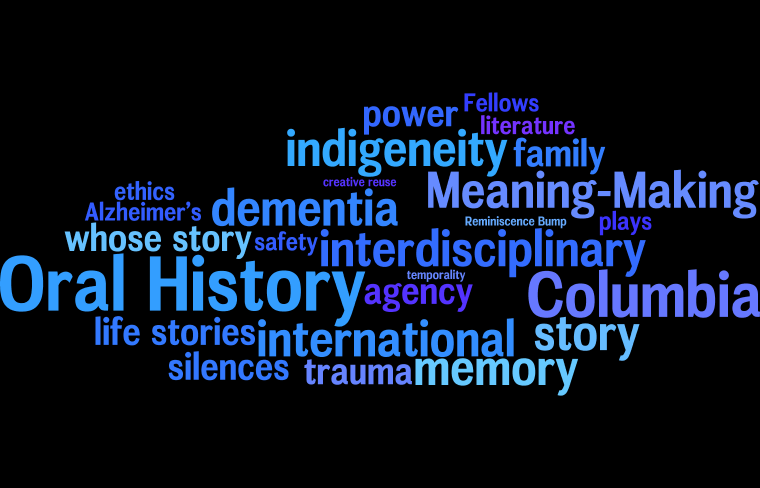
I had the immense honor and opportunity to attend the recent Columbia Oral History Institute, where Fellows from around the globe gathered to explore and discuss the topic of: Oral History and Aging: Transmitting Life Stories of Being and Becoming Across Cultures and Generations. It was an outstanding lineup of faculty, as well as a diverse group attendees. It was two weeks of intense study, lecture, and discussion, with a wealth of readings and other sources. I still haven’t processed it all. It’s going to take some time to go through my notes, continue the readings, and thoughtfully consider many of the questions that were raised. However, as I’ve done before when I’ve attended major professional conferences and events, and have lacked the time to produce fully developed posts, I thought I’d start with this Wordle of key concepts and issues that were raised for me at the Summer Institute. I hope to write more about some of these topics in the coming weeks.


History Day – and why it matters

It’s spring – and that means across the country thousands of teens are putting the final touches on their National History Day presentations.

What is History Day?

National History Day is an exciting opportunity for middle and high school students to engage with the past. They develop their own topics around a broad theme that changes each year. The 2016 theme is: “Exploration, Encounter, Exchange.” Students conduct their own research, with heavy emphasis on the use of primary sources. They analyze and interpret their findings, and their work culminates in a final project in one of the following forms: research paper, documentary video, dramatic performance, museum-type exhibit, or website. Depending on the category, students can work alone or in small groups. Students compete with others in their same general age range or grade level.

Ten Reasons History Day Rocks!

  1. It’s fun!  – Students bring and generate energy and enthusiasm for their topics, the research process, and the final outcome.
  2. It’s self-directed – Students select their own topics, and choose how to connect their subject to the contest theme.
  3. It’s challenging – Students learn to ask hard questions of sources, their teachers, and each other.
  4. It’s social – Students meet others with similar interests, learn from each other, and encourage one another.
  5. It’s inspiring – Students have a knack for finding interesting stories and presenting them in intriguing, creative, and thought-provoking ways.
  6. It’s engaging – History Day goes beyond rote dates and “facts” found in dry textbooks – and makes the past come alive. Suddenly, history is exciting again!
  7. It improves skills – Overall skills in research, critical thinking, and writing improve across all of a student’s work – not just in history class.  Technical skills such as set design, costuming, videography, web design, and others also find expression and development through History Day projects. Self-confidence grows, as does intellectual curiosity, teamwork, and social skills.
  8. Quality is rewarded – As students advance further in the contest, they find they must constantly revise and improve their work as the competition stiffens. This teaches ongoing critical thinking skills, editing, and objective assessment of their own work.
  9. There’s prizes! -Students compete at school, local, regional and state levels, before advancing to the National finals. At various levels, but particularly at the state and national levels, students may win special awards, often cash, sponsored by History Day alumni, corporate sponsors, or professional organizations; or gain other forms of recognition. Of course, the best prize of all is to advance to the next level of competition.
  10. And even scholarships! – The University of Maryland at College Park, Case Western Reserve University, and Chaminade University of Honolulu all offer scholarship prizes.
    And let me add Reason #11 — just for teachers!
  11. Teachers can win, too! – A few special prizes are awarded to teachers who exhibit leadership and encouragement to their students.

How You Can Get Involved

State and regional competitions are underway now! Contact your state coordinator and learn how you can volunteer, serve as a judge, or provide other support.

Some students may be in need of financial assistance, particularly if they advance to the national competition in Maryland in June. National History Day does not provide financial support, so most families must foot the bill themselves. Watch for students in your area to hold fundraisers or online campaigns, and contribute generously. NHD also accepts donations to aid in its operations and to get more classrooms and teachers involved in the contest.

Archives Month 2015

Interested in archives, but don’t know where to begin? Are you a family historian who has found limitations to online sources and want to delve deeper? Take a look at these guest posts at the blog on Ancestry.com:

4 Things to Know Before You Visit an Archive – Want to visit an archive, but don’t know what to expect? Read this post to learn more.

Archives Month: Searching by Context – Too often, researchers are too specific when they begin their search. Learn how using a contextual approach can aid your research.

Archives Month: Anatomy of a Finding Aid – What is a finding aid, how do I read one, and how can it help me?

Memorial Day: Remembering Oscar Pinney

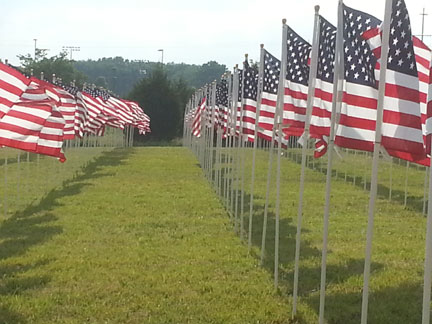
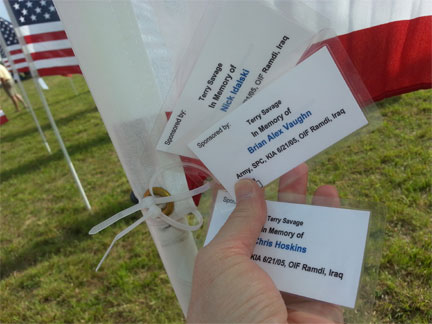
Today, I briefly visited Stones River National Battlefield, and while in Murfreesboro, also paid a visit to the Healing Field. Sponsored by the Exchange Club, the field is full of probably 200+ flags. It was a windy day, and they were all highly visible. People can “sponsor” a flag, and dedicate it to someone in the military. It was a moving tribute, and as I walked among the flags and noted some of those that were being honored, I felt as if I were among ghosts. All of those who had Gone Before. From all of America’s wars. Even some of them, only a few years ago.

FieldFlagsRow

I thought about who I might honor. Corydon Heath, whom I came to know through the story of Milliken’s Bend, and George Conn, another officer who died with Heath, were first to mind. But then, there was absolutely no local connection to Stones River or Murfreesboro at all. It didn’t seem appropriate.

So I thought, “Who do I ‘know’ from Stones River?” And I thought immediately of Capt. Oscar Pinney, of the 5th Wisconsin Battery. I learned of his story probably 20 years ago. And I remember reading his letters. And his last (extant) letter home, written a few days before Christmas – where he tells his wife that he just received a furlough – “to start tomorrow morning” – only to inform her that it has been countermanded.

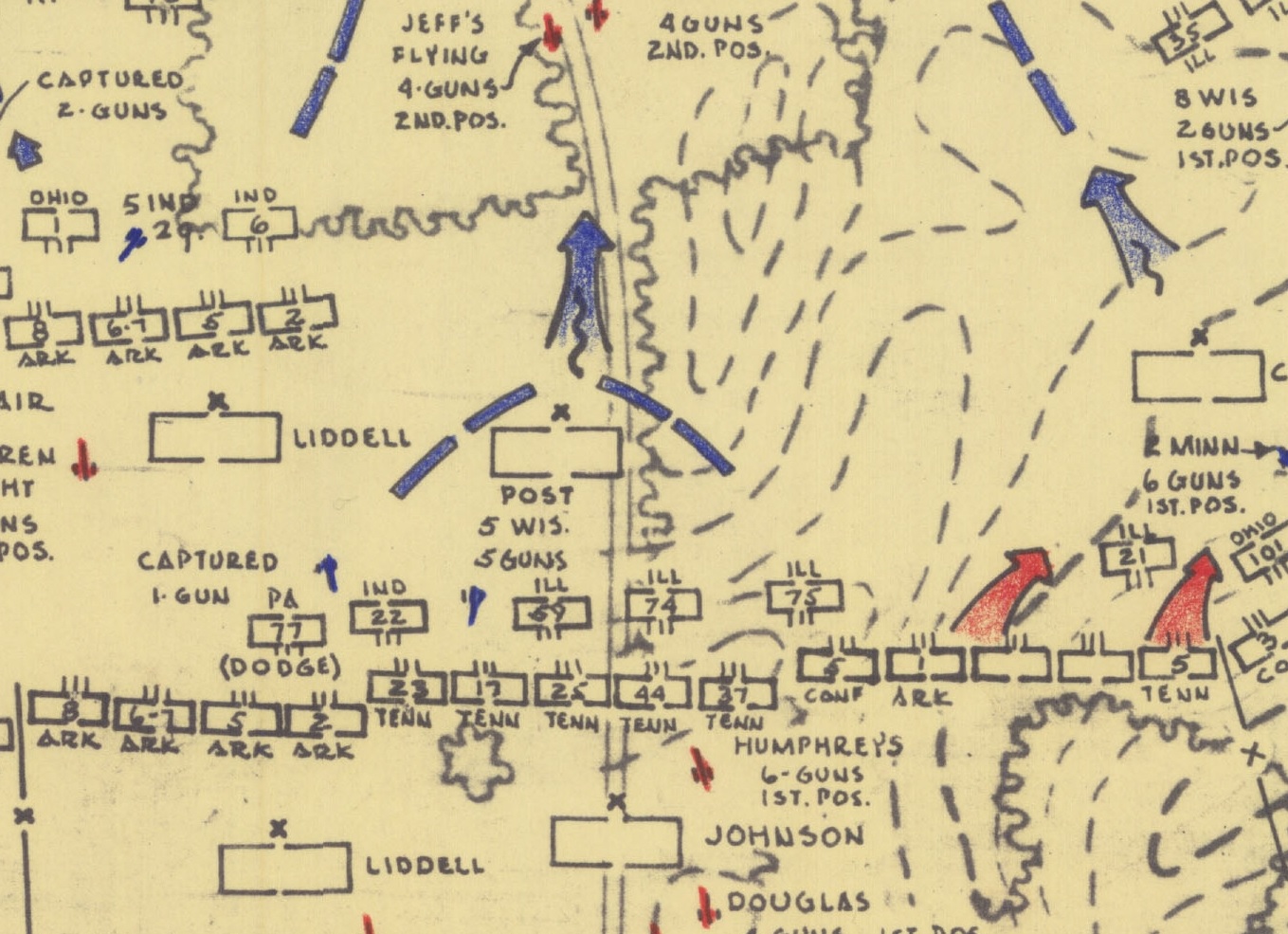
Detail of Stones River battlefield, 9am, showing Confederate onslaught. Map drawn by Ed Bearss, National Park Service

Detail of Stones River battlefield, 9am, showing Confederate onslaught. Map drawn by Ed Bearss, National Park Service

Pinney’s battery was engulfed in the early morning of Dec. 31, 1862, in the opening hours of the battle. Posted on the far Union right, and firing canister, they were nevertheless overpowered and had to withdraw their guns. Pinney was shot, and his cannoneers were forced to leave him behind. After the battle, and when the Confederates had left the field, he was still alive, but died on February 17, 1863. Several of his comrades are buried at Stones River, but Pinney’s body was sent home.

This Memorial Day, please remember his family’s sacrifice, and those of so many, many others. They did not die that you might eat more hot dogs or have an extra day off work or shop at sale. They died that we might become a stronger, more secure nation. They died because they were willing to make sacrifices that many of us are not. They died to ensure our freedom, that we so often take for granted.

HonorOIF

These men died too. Honor their sacrifice, say a prayer for their families, and shake a vets’ hand who made it back. Thank you. We are forever in your debt.

More about Oscar Pinney and the 5th Wisconsin Battery at Stones River:

Read his last letter (page 19)

A memoir by Charles C. Cunningham

More resources about Wisconsin units, including the 5th Battery, at Stones River.

Vets today:

Help those who’ve come home: Wounded Warrior Project